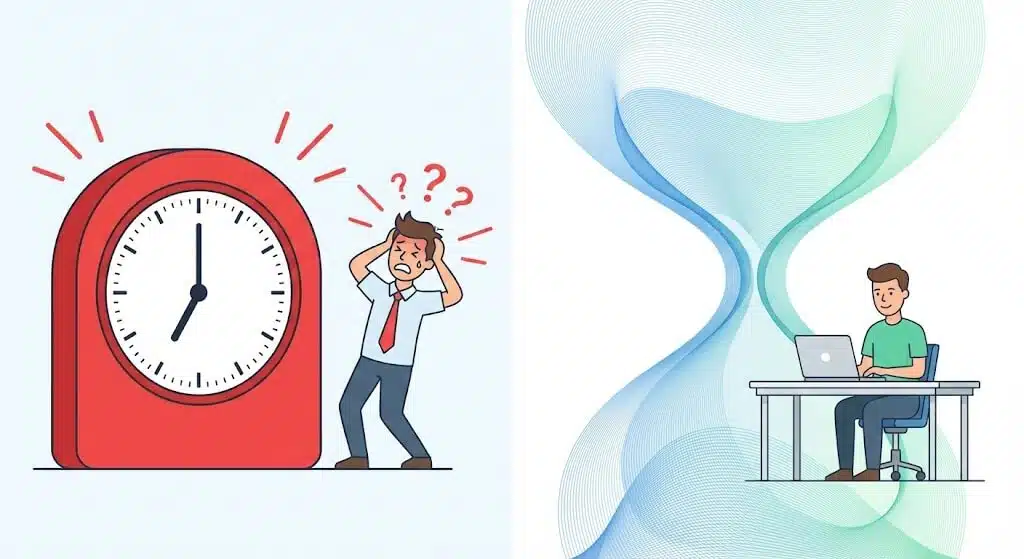

You sit down to write. You set your timer for 25 minutes. You start typing.
For the first 10 minutes, you are struggling. You are distracted. You are checking your phone. But then, around minute 15, something clicks. You find the rhythm. The words start pouring out. You are finally in the zone.
DING!
The timer goes off. It’s time for your “mandatory” 5-minute break.
You stop. You take the break. But when you come back, the magic is gone. You have to start the engine all over again.
This is the problem with the famous Pomodoro Technique. While it works wonders for administrative tasks (like clearing your inbox), it can be a disaster for creative freelancers.
If you are a coder, a writer, or a designer, you don’t need arbitrary interruptions. You need Flow.
The Problem with Rigid Timers
The Pomodoro technique assumes that all work is created equal and that your brain needs a reset every 25 minutes.
But research into Flow States (that feeling of being completely immersed in a task) shows that it takes about 15–20 minutes just to get into deep focus.
If you use a Pomodoro timer, you are effectively training yourself to stop working the moment you reach peak productivity. You are punishing your focus, not rewarding it.
Enter: The Flowtime Technique
There is a better way. It was coined by productivity expert Zoe Read-Bivens, and it is called The Flowtime Technique.
It is essentially “intuitive timeboxing.” Instead of telling your brain when to stop, you listen to your brain and stop when you are naturally depleted.
Here is how it works:
-
Pick one task.
-
Start a stopwatch. (Count up, not down).
-
Work until you feel your focus slip. This might be 35 minutes, or it might be 90 minutes. There is no alarm. You stop when you need to stop.
-
Calculate your break. The longer you flowed, the longer your break.
This method gives you data. You might realise that you are actually a “50-minute sprinter,” or perhaps you are a “90-minute marathon runner.”
The Flowtime Tracker Tool
You don’t need a spreadsheet to work this out.
I have built a simple tool below to help you test this today. Press Start Focus to begin counting up. Leave this page open in the background while you crack on with everything else you need to do. Then, when you feel yourself getting distracted or tired, press Stop & Break.
The tool will automatically calculate exactly how long your break should be based on the work you just did.
The Suggested Ratios
If you are wondering how the break times are calculated, here is the standard "Flowtime" breakdown:
-
Work 0 – 25 mins: Take a 5-minute break.
-
Work 25 – 50 mins: Take a 10-minute break.
-
Work 50 – 90 mins: Take a 20-minute break.
-
Work 90+ mins: Take a 30-minute break.
Why This Works for Freelancers
As a freelancer, your schedule is yours. You do not have to abide by the industrial 9-to-5, nor do you have to abide by the rigid 25-and-5 rule.
The Flowtime Technique respects your biology. On days when you are tired, you might do short 20-minute bursts. On days when you are on fire, you might ride the wave for two hours.
Stop managing your time. Start managing your flow.