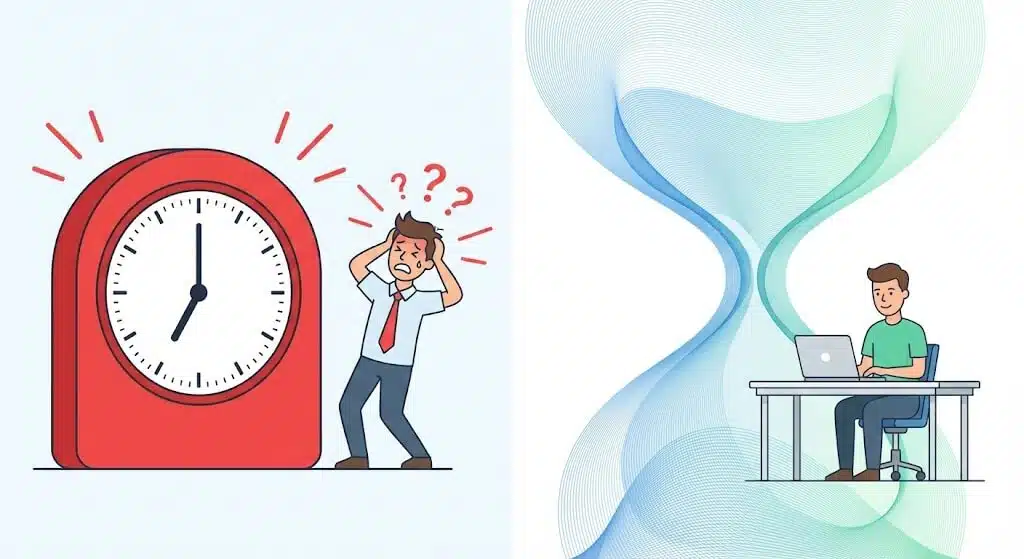

Be honest with yourself. How often do you feel guilty for not being at your desk at bang on 9am like a well trained employee?
You left the 9-5 world of being employed for freedom. You wanted to escape the commute, the office politics and the rigid timesheets. The cost of this, of course, is less security and so forth. But a payoff that is so worth it for most of us.
Yet many of us still carry around a “corporate hangover.” We feel a twinge of panic if we’re still in our pyjamas at 10:00 or we force ourselves to sit staring at a screen at 14:00 when our brains have clearly clocked off for the day and our productivity is, frankly, diabolical.
The truth is that the rigid 9-to-5 structure was built for the Industrial Revolution. It was not built not for the modern freelancer.
If you are a writer, designer, developer, or strategist, you aren’t paid for “presenteeism.” You are paid for output. It’s time to stop managing your time and start managing your energy.
Here is how to design a work day that fits your biology, not your guilt.
Why the 9-to-5 is Broken for Freelancers
In a traditional UK office, you often have to be at your desk for eight hours, regardless of how much work you actually do. But as a freelancer, your currency is focus, not hours at a screen looking like you’re working.
If you try to force high level creative work during a time of day when your brain is foggy, you are simply wasting your most valuable asset – your time. A task that takes three hours of “foggy time” might only take 45 minutes of “peak time.”
To reclaim your day, you first need to understand your Chronotype.
Identifying Your Chronotype (Are You a Lark or an Owl?)
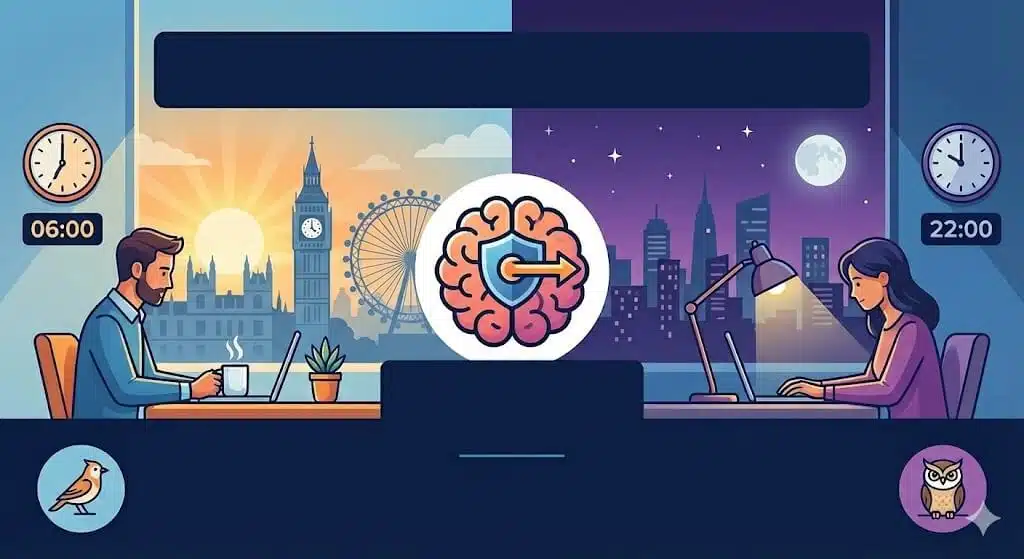
Your chronotype is your body’s natural disposition to be awake or asleep at certain times. It’s biological and is not a lack of discipline. Most researchers divide us into three camps:
1. The Lark (Early Bird)
You wake up before the alarm. You feel sharpest first thing in the morning. By 15:00, you are crashing, and you struggle to focus in the evenings.
2. The Night Owl
Mornings are a struggle. You rely on coffee to function before 10:00. However, you get a “second wind” in the late afternoon or late evening. This is when your best ideas happen.
3. The Third Bird
You fall somewhere in the middle. You have decent energy in the morning, a slump in the mid-afternoon (the post-lunch dip), and a recovery in the early evening. Note: Most of the population falls here.
Action Step: For the next three days, don’t just track your hours. Track your energy. Note down when you feel “in the zone” and when you feel like you’re wading through treacle.
The Chronotype Calculator
Want a bit of help determining which of these you might be? This isn’t an in depth chronotype test, but is a simple calculator to help you determine which of those 3 profiles you might fit.
Deep Work vs. Shallow Work: The Batching Method
Once you know your type, you need to categorise your tasks.
-
Deep Work: High-concentration tasks that move the needle. Writing copy, coding complex features, editing video, strategy planning. This requires 90–120 minutes of uninterrupted focus.
-
Shallow Work: Low-concentration logistical tasks. Invoicing, updating your CRM, replying to Slack messages, sorting out your Self Assessment tax return.
The Golden Rule: Never waste a “Peak Energy” block on Shallow Work.
If you are a Lark, checking your emails at 08:00 is a productivity sin. You are wasting your sharpest mental hours on admin. If you are an Owl, trying to write a complex proposal at 09:00 is futile; save that time for the admin.
Sample Schedules: What This Actually Looks Like
Here is permission to ignore standard business hours.
Scenario A: The Early Riser (The Lark)
-
06:30 – 09:30: Deep Work. The house is quiet. Do the hardest thing on your to-do list now.
-
09:30 – 10:30: Breakfast, shower, walk the dog.
-
10:30 – 12:30: Meetings and Calls. You are still alert enough to be professional.
-
12:30 – 13:30: Lunch.
-
13:30 – 15:30: Shallow Work. Clear the inbox, chase invoices. Your brain is tiring, so do the tasks that don’t require heavy thinking.
-
15:30: Clock off.
Scenario B: The Night Owl
-
10:00 – 11:30: Wake up slowly. Coffee. Shallow Work (Emails, social media scheduling).
-
11:30 – 12:30: Gym or a long walk.
-
13:00 – 17:00: Client work and meetings. This aligns with the UK afternoon (and the US morning if you have international clients).
-
17:00 – 19:00: Break. Dinner. Time with family.
-
20:00 – 23:00: Deep Work. No notifications, no emails. Just you and the work.
Managing the “Rest of the World”
The biggest fear freelancers have about ditching the 9-to-5 is: “What will my clients think if I don’t reply immediately?”
You can manage this without being available 24/7.
1. Use “Schedule Send” Religiously If you are a Night Owl working at midnight, do not send that email to your client now. It sets a bad precedent. Use the “Schedule Send” feature in Gmail or Outlook to make the email arrive at 08:45 the next morning. You look hyper-organised; they never know you wrote it in your pyjamas at 1 am.
2. Define Core Hours State in your contract or email footer: “My core communication hours are 10:00 – 14:00.” This creates a window where clients know they can reach you, leaving the rest of the day protected for Deep Work.
3. Respect the School Run If you are a parent, stop pretending you are working between 15:00 and 16:00. Block it out. Trying to multitask through the school pick-up just leads to mistakes. Make up the hour later in the evening if you need to.
Conclusion
Your schedule is a tool, not a cage. As a freelancer, you have the autonomy to build a day that maximises your output and happiness.
It might feel strange to start your “real work” at midday, or to finish for the day at 2 pm. But if you are producing better work in less time, you aren’t being lazy—you’re being efficient.
Give it a go: Try shifting your schedule by just two hours next week to match your chronotype.