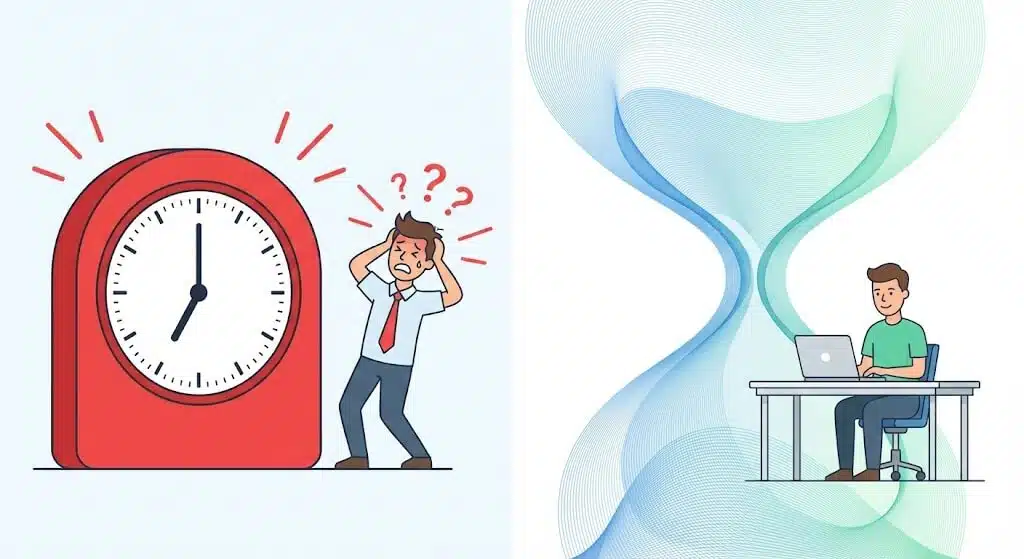

I’m not afraid to admit that I’ve had days where I’ve sat at a screen for 8 hours and ultimately, by the end of the day, feel like I have achieve the wonderful sum total of absolutely naff all. Productivity is a wild animal, isn’t it? Some days you work for 2 hours and polish off you entire day’s to do list and half of the next day. Sometimes you sit at a screen for 8 hours and seemingly get nothing done. For that reason, I’ve developed something of an obsession with fine tuning productivity, trying and testing techniques and tools and ultimately looking to optimise my time to get more done with fewer screen hours. Today I want to share some thoughts on “energy mapping,” a process I followed a couple of years ago to help me map my most productive hours to the tasks that need it most. Let’s dive in.
Tracking the highs and the lows
To get started you need to play detective with your own biology for a few days. I call this the energy audit. For three working days I want you to set a timer on your phone for every hour. When it pings you just need to jot down a quick number between one and ten for your energy levels and your focus. Don’t overthink it. A one is “I am literally nodding off over my keyboard” and a ten is “I am a productivity god and could solve world peace before lunch.” What you’ll start to see is a pattern. I discovered that I have a massive spike in clarity around 10 am but by 2 pm I am essentially a decorative vegetable. Most of us try to push through those slumps with more caffeine but that’s just masking the problem. By tracking it you stop blaming yourself for being lazy and start seeing it as data. It’s much easier to plan a workday when you know exactly when your brain is actually going to show up for work.
Sorting your tasks into energy buckets
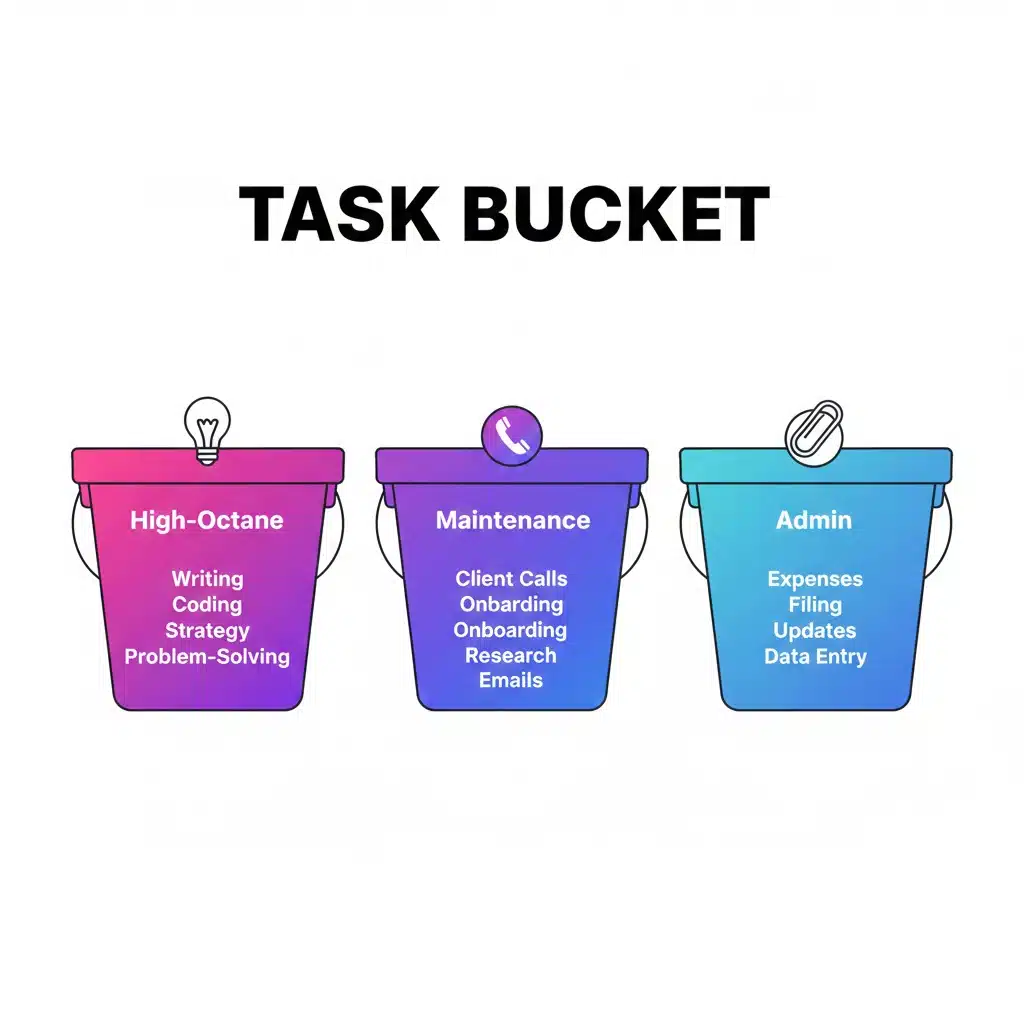
Once you have your map you need to look at your to do list through a different lens. I like to group my work into three distinct piles based on how much “brain tax” they levy. First you have your heavy lifting. For me that’s writing deep copy or untangling a complex strategy. These need a level ten energy. Then you have your middle ground like client calls or doing a bit of research. Finally you have the fluff. This is the stuff like filing expenses or tidying up your inbox. The mistake I was making was trying to do my heavy lifting at 3 pm when my brain was already halfway out the door. Now I protect my peak hours for the stuff that actually moves the needle on my business. If I’m in a low energy trough I don’t beat myself up anymore. I just pull out the “admin bucket” and do the boring bits that don’t require much thought. It feels like a massive win because I’m still being productive but I’m not fighting my own biology to do it.
Setting boundaries with your schedule
The hardest part of this is sticking to it when the rest of the world seems to run on a standard nine to five. If your peak energy is at 8 am but you spend that time answering emails you are effectively throwing away your best work for the sake of an empty inbox. I started being much more intentional with my calendar. I block out my high energy zones as “deep work” and I don’t let anyone book meetings during those times. You might worry that clients will be annoyed if you don’t reply instantly but the reality is they care more about the quality of your work than how fast you can type “noted” in an email. Being a freelancer means you have the power to design your day. If you work best at 7 pm then work then. Use your energy map to build a schedule that lets you get the work done in four focused hours rather than eight distracted ones. It’s the quickest way I’ve found to actually reclaim my evenings and weekends.